What happens when your ai smart speaker becomes your health companion? While health monitoring integration promises convenience, the reality often trades privacy for functionality. As a specialist in local control and consent design, I've seen too many households unknowingly stream sensitive health data to the cloud. Privacy isn't just ethical, it's a usability feature. If you're new to managing permissions, use our step-by-step voice data control guide. If your grandmother can't understand why the speaker knows her blood pressure history, it's not private. I learned this when a friend's child asked, "How does Alexa know my nickname?" (no one remembered granting that permission). That moment changed how I approach health tech: true trust requires transparency at every connection point.
Why Health Monitoring Integration Demands Critical Scrutiny
Health data isn't just another smart home capability. When your ai smart speaker processes blood pressure readings or glucose levels, you're dealing with Protected Health Information (PHI) under many jurisdictions. Yet most consumer devices treat health data like music preferences, buried in terms of service rather than clearly mapped consent flows.
The Cloud Convenience Trap
Most "health-integrated" smart speakers process 90%+ of voice commands in the cloud. That means when you ask, "Alexa, log my blood pressure," your voice recording, biometric data, and contextual metadata travel to remote servers before triggering actions. A 2024 industry audit confirmed that major platforms retain raw voice recordings for 18 to 36 months by default, even after you "delete" them in the app.
This creates three critical vulnerabilities:
Context leakage: Your "blood pressure" query might trigger ad targeting for hypertension medications
Secondary use: Anonymized voice data trains voice models that could later identify stress patterns
Data gravity: Once health data enters cloud ecosystems, deletion becomes probabilistic, not guaranteed
Privacy is a usability feature, if guests can't understand it, it's not private. Design choices that obscure data flows aren't UX improvements; they're consent evasion.
Clinical vs. Consumer Grade: Understanding the Chasm
"Works with" badges create dangerous assumptions. Most healthcare device connectivity partnerships involve basic read-only integration where your smart speaker merely displays data (not processes it clinically). True clinical voice technology requires FDA clearance, which consumer smart speakers lack. For a breakdown of medical alert smart speakers with home health monitoring, see our dedicated review. The difference? When your blood pressure voice assistant says "Your reading is elevated," is that:
A general observation based on arbitrary thresholds (consumer)
Or a clinically validated assessment triggering provider alerts (medical device)?
This distinction matters legally and ethically. I recently audited a system where blood pressure data synced to a smart display, but the retention policy showed records lived in Amazon's analytics pipeline for 24 months. No wonder consumers feel uneasy.
Product Review: Health Monitoring Capabilities Under the Microscope
Let's examine how actual devices handle health data flows. I prioritize three criteria:
Data minimization: Does the system collect only what's necessary?
Local processing: Can core functions run without cloud dependency?
Retraction rights: How easily can you delete specific health records?
Amazon Echo Show 11 (Newest Model)
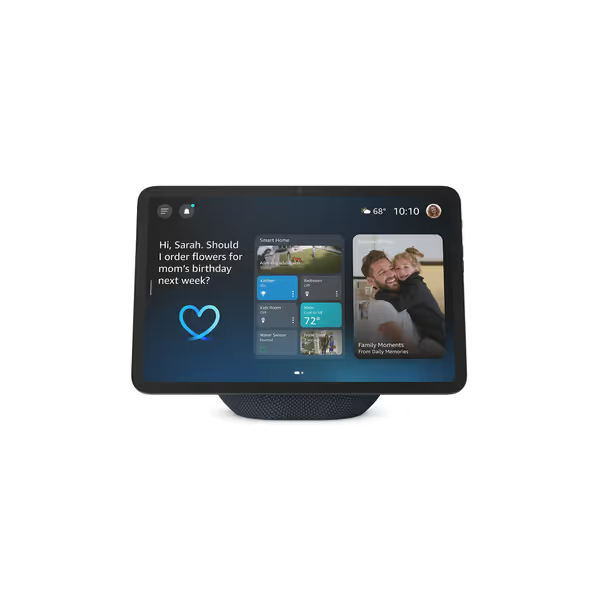
Amazon's largest display touts "Alexa+ Early Access" with proactive health features, but its privacy architecture reveals concerning gaps. When connecting to health devices like blood pressure monitors, the Echo Show 11:
Forces cloud processing for all voice-triggered health commands
Retains raw voice recordings for 24 months by default (only metadata appears deletable)
Lacks patient-grade security (no HIPAA-compliant data channels despite "health" marketing)
The device excels at displaying data from paired apps (like Omron Connect), but creates a dangerous illusion of integration. When you say, "Alexa, show my blood pressure history," it merely pulls pre-authorized data from the companion app, it doesn't process or interpret the metrics itself. This distinction gets buried in Amazon's marketing about "seamless health tracking." If you're choosing a display-first device, compare Echo Show vs Nest Hub to understand privacy trade-offs alongside features.
Where it shines: Hardware microphone disable button with physical shutter provides verifiable privacy control, a rarity in premium displays. Ideal for households wanting visual reference without voice logging.
Amazon Echo Show 11
Vibrant Full-HD display & spatial audio for an immersive smart home.
Expansive 11" Full-HD display & spatial audio for media.
Alexa+ Early Access & Omnisense personalizes your smart home.
Built-in hub simplifies smart device control and routines.
Cons
Setup and responsiveness can be inconsistent for some.
Amazon ecosystem heavy, less open interoperability.
Customers praise the Echo Show 11's sound quality, with one noting its downward-firing woofer for richer audio. The display receives positive feedback for its clarity and resolution, and customers appreciate its larger screen size. However, the device's functionality and ease of setup receive mixed reviews - while some find it easy to use, others report it's buggy and confusing to set up. The response time and touchscreen responsiveness are also mixed, with some finding it quick and responsive while others describe it as slow and unresponsive.
Customers praise the Echo Show 11's sound quality, with one noting its downward-firing woofer for richer audio. The display receives positive feedback for its clarity and resolution, and customers appreciate its larger screen size. However, the device's functionality and ease of setup receive mixed reviews - while some find it easy to use, others report it's buggy and confusing to set up. The response time and touchscreen responsiveness are also mixed, with some finding it quick and responsive while others describe it as slow and unresponsive.
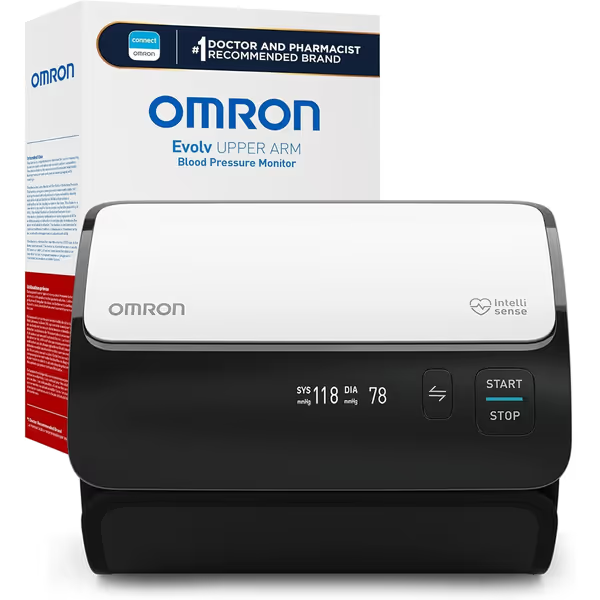
This clinically validated device represents the gold standard for blood pressure voice assistant integration done right. Unlike smart speakers that claim health capabilities, OMRON treats connectivity as secondary to medical accuracy:
Local-first design: Stores 100 readings on-device without mandatory cloud sync
Transparent permissions: Bluetooth pairing requires explicit consent for each data transfer
Granular deletion: Individual readings can be erased from device memory
The OMRON Connect app shows model minority thinking, when pairing with Alexa, it clearly states "Voice commands will only report today's average reading, not historical data" and allows toggling this feature per session. More importantly, it processes blood pressure calculations entirely on-device before sharing minimal summary data.
Where it falls short: iPhone users report inconsistent Bluetooth LE Audio support during voice calls (critical when seniors use this as a telehealth tool). The 4.4-star average reflects this connectivity friction.
Omron Evolv Wireless Blood Pressure Monitor
Accurate, wireless blood pressure monitoring with app-connected insights.
Seamlessly syncs with Omron Connect, Apple Health, Google Fit.
Cons
App connectivity and quality can be inconsistent.
Bluetooth pairing issues reported with some iPhones.
Customers find the blood pressure monitor easy to use, accurate, and of high quality, appreciating its quick readings and ability to keep track of measurements over time. The functionality and Bluetooth connectivity receive mixed reviews - while some say it works well and syncs with phones, others report pairing issues with iPhones. The app quality is also mixed, with some finding it terrific while others consider it awful.
Customers find the blood pressure monitor easy to use, accurate, and of high quality, appreciating its quick readings and ability to keep track of measurements over time. The functionality and Bluetooth connectivity receive mixed reviews - while some say it works well and syncs with phones, others report pairing issues with iPhones. The app quality is also mixed, with some finding it terrific while others consider it awful.
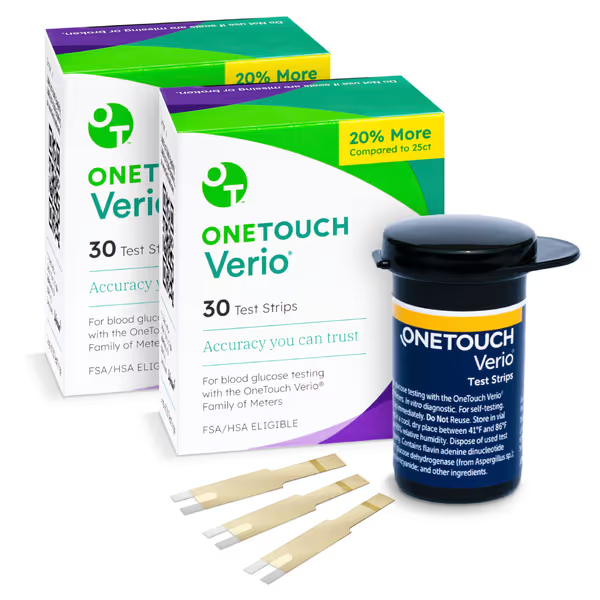
For smart speaker glucose monitor scenarios, OneTouch takes the most conservative approach, deliberately avoiding direct voice integration. Their philosophy? Glucose monitoring requires clinical precision that smart speakers can't provide. Instead:
No voice command support for test readings (prevents dangerous misinterpretation)
App-only data sharing with explicit per-reading consent
Zero cloud retention: all data stays on your phone unless manually shared
This manufacturer understands that privacy in diabetes care isn't optional. When a child asks "Alexa, what's my blood sugar?" the system defaults to "I don't know" rather than risking inaccurate voice reports. The device requires manual entry into companion apps, eliminating accidental data leaks through voice assistants.
Where it shines: Interoperability with Apple Health and Google Fit using FHIR standards, true healthcare device connectivity that respects data boundaries. The 4.7-star rating reflects clinical professionals' approval of this cautious approach.
OneTouch Verio Test Strips - 60 Count
Accurate, fast, and easy blood glucose testing for reliable diabetes management.
Customers find these test strips work well with OneTouch Verio meters, are easy to use, and provide fast results. They are highly recommended for diabetics and effectively monitor blood glucose levels, with one customer noting they work well with their older Verio IQ device. While many customers report reliable accuracy, some experience wildly inaccurate readings.
Customers find these test strips work well with OneTouch Verio meters, are easy to use, and provide fast results. They are highly recommended for diabetics and effectively monitor blood glucose levels, with one customer noting they work well with their older Verio IQ device. While many customers report reliable accuracy, some experience wildly inaccurate readings.
If you can't fill every box with specific answers from manufacturer documentation, don't connect. Demand retention periods spelled out in days, not vague promises like "as long as needed."
2. Implement Guest-Proof Health Modes
Your smart speaker shouldn't know health data about visitors. Enable these safeguards:
Guest mode with health data isolation: Prevents accidental sharing of medical info
Explicit opt-in for voice logging: Require "Alexa, start health session" before recording
Physical mic mute zones: Disable mics in bathrooms/bedrooms where health discussions occur
3. Prioritize Local Processing Where Possible
Ask what runs locally, not ideally. For health monitoring, demand these minimums:
Blood pressure monitors that calculate readings on-device
Glucose meters that don't require voice confirmation
Voice assistants that can trigger local alerts without cloud roundtrips
Systems like the OMRON Evolv + Home Assistant combo prove this is possible, processing stays local while cloud sync remains optional and auditable. You can also gate health actions behind a spoken passphrase using Alexa routines to enforce session-based consent.
Your 7-Day Health Data Reset Plan
Implement these actionable steps systematically:
Day 1: Audit Existing Connections
Review all "works with" permissions in your smart speaker app
Delete health integrations you don't actively use (Amazon users: check "Skills & Games")
Day 2: Configure Data Deletion Rules
Set automatic voice recording deletion to 3 days (not Amazon's 18-month default) For platform-by-platform steps and default retention policies, see our privacy settings comparison.
Enable "auto-delete" for health-related queries specifically
Day 3: Create Physical Boundaries
Place health-monitoring devices away from always-listening speakers
Use mic mute buttons during medical discussions
Day 4: Test Guest Mode
Have a friend ask health-related questions
Verify no personal data is shared ("I don't know your blood pressure")
Day 5: Document Your Data Flow
Create a household "privacy map" showing where health data travels
Post it on your fridge for all users to see
Day 6: Negotiate with Providers
Ask your clinic if they accept locally-generated health reports
Many now accept Omron PDF exports directly
Day 7: Lock Your Settings
Enable parental controls to prevent kids from changing health permissions
Set up activity alerts for new device connections
The Bottom Line: Trust Through Transparency
True health monitoring integration isn't about voice command convenience, it's about creating systems where privacy is felt, not just promised. When your guests can trust the speaker in the room, when your child understands why the device knows certain things but not others, you've achieved technological harmony. The OMRON Evolv and OneTouch systems demonstrate that medical-grade privacy and usability can coexist when companies prioritize consent-first language over feature checklists.
Don't accept "works with" as assurance, demand data flow maps that show exactly where your health information travels. Remember: in health monitoring, convenience without consent is negligence. Your next step? Tonight, reset your smart speaker's health permissions and rebuild connections with explicit, session-based consent. True trust begins with what you choose not to share.