
Voice Search for Plumbers: Win More Calls
19th Feb•12 min read
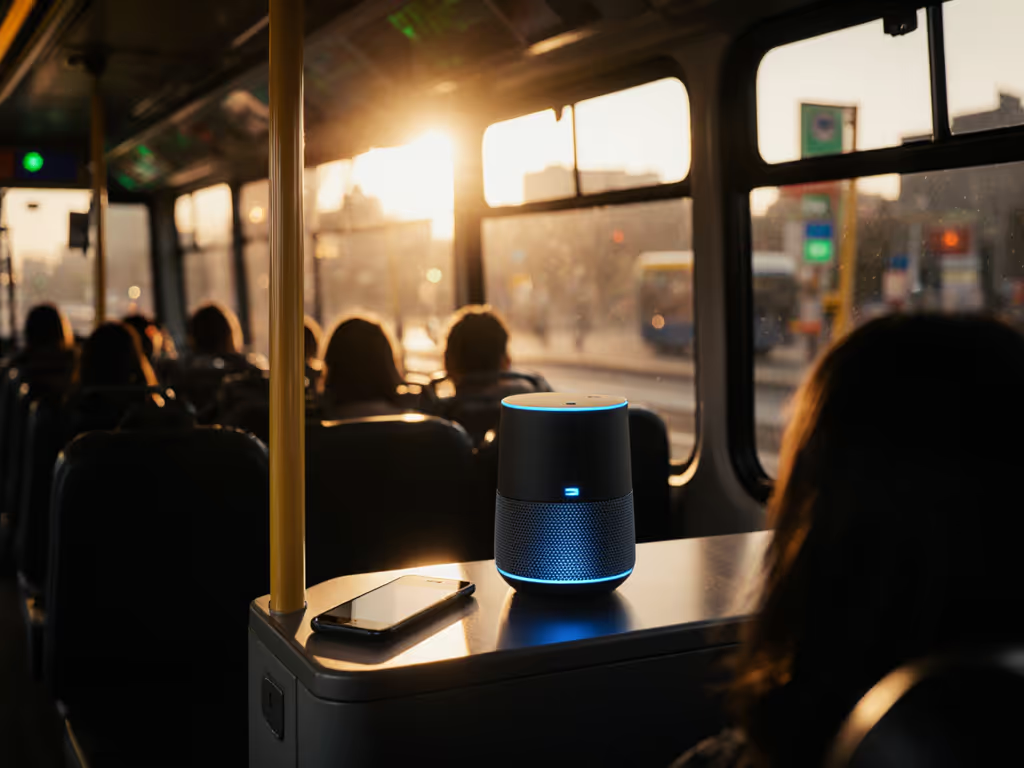
You're standing on a crowded platform, running late, and you want to ask your phone: "When's the next train to Central Station?" Sounds simple enough, and public transportation voice control promises exactly that convenience. But ask anyone who's tried using voice commands for transit, and you'll hear a familiar refrain: it works sometimes, fails mysteriously other times, and leaves you frantically checking an app anyway. For how assistants handle accents and noisy environments, see our voice recognition accuracy tests.
The gap between promise and reality reveals something important about how smart commuting assistants handle transit data. Let's dig into what actually works, why the gaps exist, and what to expect before you rely on voice for your commute.
The core problem isn't the microphone or the voice engine, it's the data flow. Transit data is fragmented across hundreds of independent agencies, each running different systems, using different formats, and updating at different cadences. A transit agency that deploys real-time information systems faces a complex undertaking, as they must integrate dozens of voice announcement systems with sensitive priority rules for messaging.[1] That infrastructure-level fragmentation cascades down to consumers: your phone doesn't have a unified source of truth about routes, delays, or accessibility across cities.
When you ask a voice assistant for your subway route, it's not querying a live system directly, it's often making an API call to a third-party transit app, waiting for a response, then synthesizing that into spoken words. For a clear look at what happens from wake word to answer, read our voice search technology explainer. Each step introduces latency, and each step is a potential failure point. Data you never collect can't leak, but the corollary is also true: if the data doesn't exist in a standardized, accessible format in the first place, voice assistants can't reliably serve it to you.
Additionally, privacy and consent matter here too. Transit agencies increasingly collect location data, ridership patterns, and journey histories. If your voice assistant is integrating with a transit app that collects behavioral data, you're inheriting its retention policies, which may not be transparent. More on that below.
Voice works reasonably well for the static parts of transit:
Bus schedule voice commands for routes you've already saved are reliable. Ask "When's the next bus on the 5 line?" and if you've favorited that line in your transit app, a smart speaker integration can pull that data. The voice assistant isn't reasoning about the entire transit network; it's retrieving a pre-fetched, slow-moving dataset.
Train timetable voice assistant features work similarly. If the timetable doesn't change mid-query, voice can serve it. This works because the system doesn't need real-time processing, it's essentially reading from a printed schedule.
Voice is also useful for transit app integration when you're already in the app. "Show me alerts for my saved routes" or "Read me the status of the Red Line" work because you've already narrowed the scope and consented to that app's data practices.
Real-time delays and crowding: When you ask for dynamic information such as "How crowded is the 6 train right now?" or "Is there a delay on the Brown Line?", you're asking the system to synthesize live data from multiple sources and make a judgment call about what's relevant to you. Current systems struggle with this because:
Multi-agency trips: Ask for a route that combines walking, bus, and subway (especially across different agencies), and voice assistants often fail. They can't reason through complex decision trees, weigh trade-offs ("faster but more walking vs. fewer transfers but longer"), or explain alternatives naturally. You end up switching to the map app anyway.
Accessible station information: Transit agencies are required to announce accessibility features (elevators, accessible entrances, platform gaps) under standards like the ADA.[2] But voice control systems rarely have access to this data in structured form, so they can't reliably tell you "Does this station have an accessible entrance?" If they do answer, it's because they're reading from stale, manually maintained lists, not live sensor data. For riders who depend on accessible navigation, our voice assistant accessibility features guide outlines reliable options and settings.
This is where Amina's skepticism kicks in. When you use a smart commuting assistant for transit, you're usually creating a data trail:
Many transit agencies have opaque data retention policies. Some retain location data indefinitely; others anonymize after 30 days. Most users don't know which camp their agency falls into. And if you're using a voice assistant that's cloud-dependent, you're adding a layer of retention from the voice platform itself. To reduce exposure and manage recording retention, follow our smart speaker privacy checklist.
Local-first defaults matter here. A voice assistant that processes transit queries on-device (rather than always sending audio to the cloud) reduces the retention risk. But most mainstream assistants don't work that way; they're built for cloud processing and cloud-backed integrations.
The good news: transit agencies are investing in AI-driven passenger information systems. Three-quarters of European transit agencies are projected to be piloting or have deployed AI in their operations by 2026.[3] In practice, this means:
But these remain early-stage. Integration takes years, and voice assistants prioritize consumer-facing features over transit reliability.
Use voice for:
Don't rely on voice for:
The pattern? Voice works when the data is static, pre-filtered, and pre-consented to. It fails when you need real-time synthesis, privacy-respecting routing, or nuanced judgment calls.
For public transportation voice control to mature, three things have to align:
Until then, treat voice as a helpful supplement, not your primary way to navigate transit. Check the app, glance at the alerts, and use voice to confirm what you already know. That's when it shines, and where it's actually reliable.
Interested in how smart home assistants handle other real-time data? Dig into how transit app integration compares to voice control for weather, news, or traffic. You'll notice the same pattern: voice excels at stable, pre-authorized data and struggles with dynamic, privacy-sensitive information. Understanding that boundary helps you choose the right tool for the job, and keeps you from wasting time talking to a speaker when you should be checking your phone.