Senior Living Facility Voice Assistants: Private, Scalable Care
29th May•14 min read
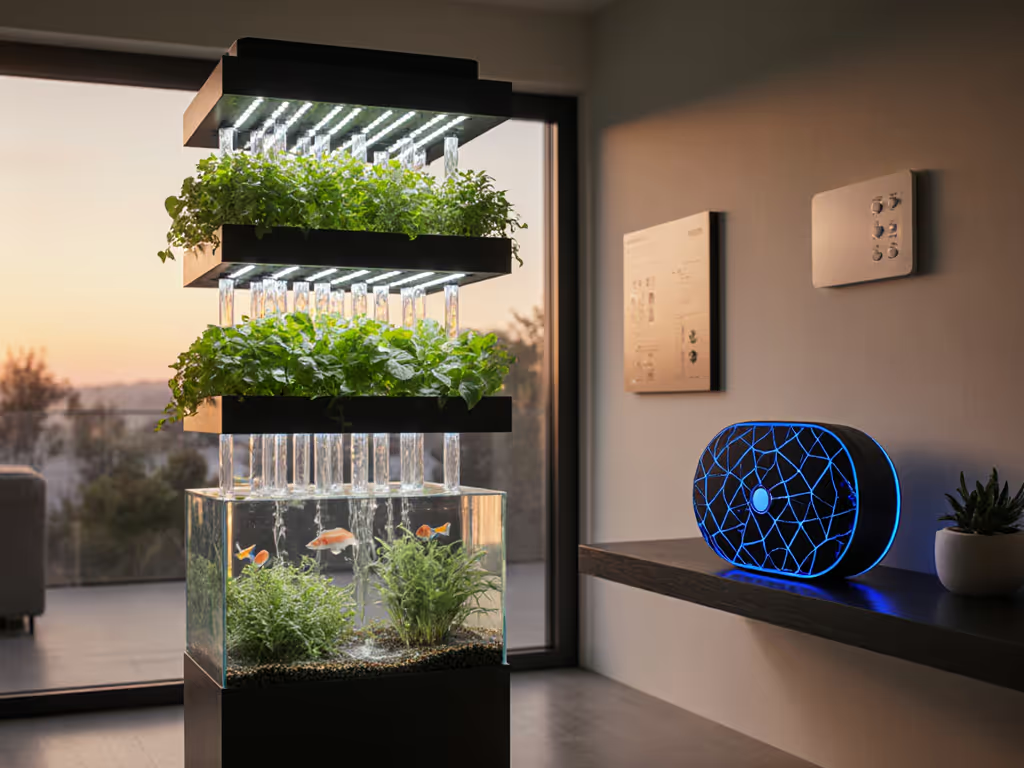
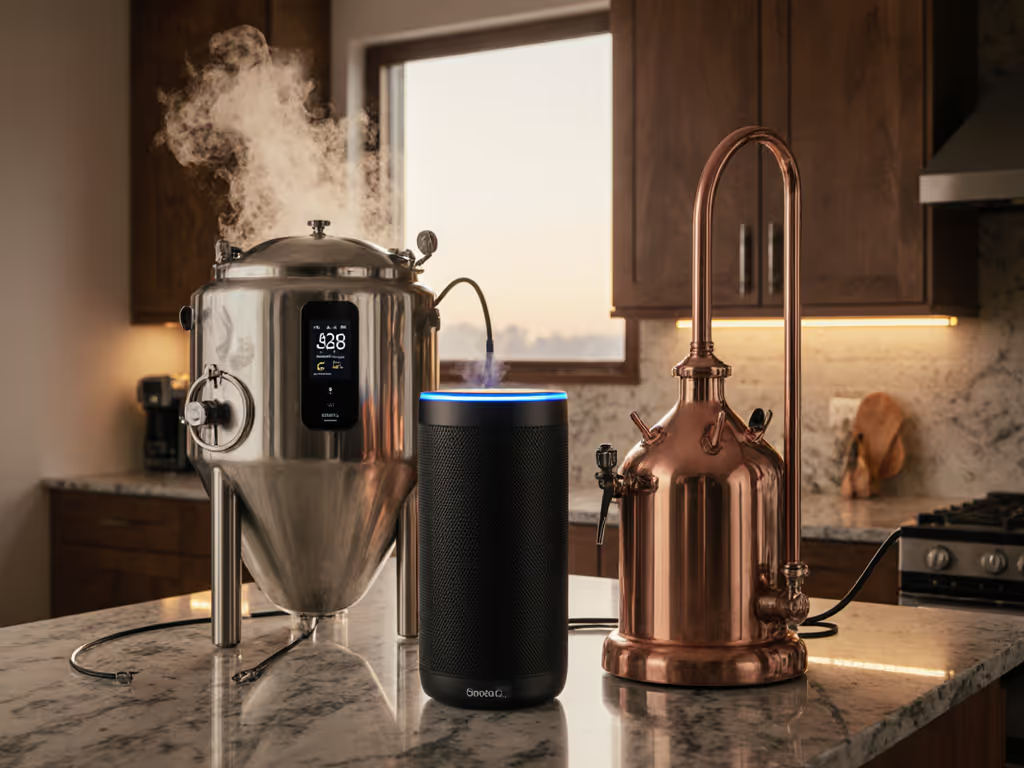
Voice-controlled aquaponics and hydroponic systems represent a compelling vision: imagine asking your home assistant to adjust water pH, trigger nutrient dosing, or report sensor readings from your indoor farm while you're at work. Yet the reality is far messier. Hydroponic smart speaker ecosystems remain fragmented, standards adoption is inconsistent, and most "smart" gardening products still default to proprietary cloud control rather than open interoperability. For a broader view of platform compatibility, see our smart home ecosystem comparison. This FAQ unpacks the gap between the promise and the practical landscape, and why measurement, not marketing, must guide your choices.
The short answer: consumer aquaponics is too niche, and the smart home ecosystem hasn't converged on unified APIs for environmental sensors.
Most voice-controlled aquaponics setups today are Frankenstein arrangements: a wireless pH probe from one vendor, a smart outlet for the pump from another, and a Home Assistant or Hubitat hub stitching them together via custom automation. If you need to bridge gaps between devices and services quickly, our IFTTT integration guide shows practical, low-code workflows. The fragmentation mirrors the broader smart home pain: Apple HomeKit, Amazon Alexa, Google Home, Samsung SmartThings, and Home Assistant each have their own capability model. If you plan to run multiple assistants side by side, our mixed voice assistant guide covers conflict-avoidance and coordination tactics. A sensor that reports temperature to HomeKit may not speak to Alexa, and both may lack Matter support (the standard that promised interoperability but still requires explicit device certification).
Aquaponics vendors have been slow to adopt these standards because the addressable market is small, integrations carry certification costs, and many growers are content with a phone app. Measure, don't guess: ask any prospective smart gardening voice command system whether it supports local API access, whether it survives internet outages, and whether it exposes data in a standards-compliant format (Thread, Matter, MQTT, or REST). Most won't pass that audit.
HomeKit (Apple) leads in local processing; Alexa and Google Home excel at breadth but struggle with privacy defaults; Home Assistant dominates for open-source flexibility but demands technical upkeep.
Here's what I test with mixed-brand households:
Apple HomeKit: Requires HomeKit-certified accessories (rare for aquaponics hardware) but executes automations locally on a HomePod mini hub if your Wi-Fi and networking are sound. No cloud dependency for basic logic. The trade-off is limited third-party sensor integration, so you're mainly constrained to Apple's ecosystem.
Amazon Alexa: Broadest device compatibility, but most aquaponic garden voice control flows run through AWS servers. Latency from sensor → cloud → Alexa → action can stretch to several seconds. Privacy concern: voice clips are retained unless you disable it explicitly per device.
Google Home: Similar breadth to Alexa, with faster processing in some cases due to Google's infrastructure. Matter support is expanding, which helps. Local automations are limited compared to HomeKit.
Home Assistant: Open-source hub with no cloud requirement. You can ingest data via MQTT, REST, or native integrations. Setup burden is high (YAML configs, networking complexity, manual updates), but the payoff is full local control and reproducibility. This is the path I choose when reliability and auditability matter.
Test end-to-end latency and failure modes before committing. Cloud-dependent systems fail in ways you can't predict.
I measure three thresholds:
Sensor-to-action latency (under 2 seconds for water level; under 5 seconds for pH adjustments that aren't critical). Anything slower and you're waiting for feedback; anything dependent on cloud round-trips is unpredictable.
Internet outage resilience (does dosing or pump logic continue locally if Wi-Fi drops?). If your hydroponic system monitoring relies on a webhook or cloud API, a service outage silences your entire setup. Local automation, via a hub or gateway running local rules, keeps essentials functioning.
Multi-room drift (if you have multiple tanks or zones, do they respond at the same moment, or does one lag?). Synchronization failures are subtle but corrosive; I've watched clients lose crops because a second tank's cooling pump lagged by 10 seconds, allowing temperature to spike. This is where standards like Thread (mesh radio with millisecond jitter ~30 ms) outperform Wi-Fi (jitter can exceed 100 ms under household load).
Matter is the permission slip for interoperability; Thread is the radio protocol that actually delivers reliable local mesh. Together, they reduce lock-in, but adoption remains patchy in the gardening niche.
Matter defines a common language (a sensor reports "current temperature" the same way to HomeKit, Alexa, or Home Assistant). Thread uses an IEEE 802.15.4 mesh at 2.4 GHz to forward messages without Wi-Fi, with latency around 50 to 100 ms even in congested homes. The promise: plug in a Thread-enabled pH probe, and it pairs with any Matter-certified hub, then speaks to any Matter-aware app.
The reality: very few aquaponics sensors are Matter-certified. Most are still Wi-Fi-only or Z-Wave or Zigbee (older standards with slower adoption curves). If indoor farming voice assistant setup is your goal, check the device spec sheet for explicit Matter and Thread support, not just "works with Alexa." The phrase "works with" often means cloud-bridged compatibility, not local mesh or open standards.
Different radio stacks (Wi-Fi, Zigbee, Thread), cloud routing, and inconsistent firmware update schedules introduce millisecond-to-second delays. Enough to unsync dosing across tanks.
Imagine two hydroponic racks: one's sensors connect via Wi-Fi, the other via Zigbee bridge. Both send data to a cloud coordinator, which triggers both pumps. Wi-Fi latency (50 to 150 ms) plus Zigbee latency (20 to 80 ms) plus cloud round-trip (30 to 200 ms depending on region) means the pumps fire out of sequence. Over a growing cycle, that offset compounds, and one tank gets slightly more nutrients or light cycles that drift by cumulative seconds per day.
I rebuilt a network last year where this exact pattern emerged: one growing chamber's pump was cycling on average 3 seconds behind the other, invisible until I logged timestamps. The crop yields diverged. After swapping the Wi-Fi sensors to Thread and replacing the cloud coordinator with a local Home Assistant hub running Room Assistant for presence, the latency variability dropped to +/- 20 ms. Measurable, reproducible, fixable.
Use local voice wake-words (not cloud-dependent), mute hardware switches on microphones, and store sensor logs locally, not in vendor databases.
Most voice-controlled aquaponics systems default to always-listening mics feeding cloud speech recognition. To lock down recordings and data retention across platforms, start with our smart speaker privacy guide. For a private system:
This posture is neither paranoid nor excessive; it's the standard I apply to any system that depends on continuous sensor monitoring in a home. Vendor lock-in and privacy erosion feed each other. Open standards like Matter and MQTT, paired with local hubs, break that loop.
The hydroponic smart speaker category won't consolidate until vendors prioritize standards compliance over proprietary walled gardens. Watch for:
Until then, I test with mixed-brand households as a baseline: if I can't integrate a new sensor without vendor lock-in or cloud dependencies, it doesn't earn space in my setup. Your tolerance may differ, but the measurement framework, latency thresholds, failover behavior, sync drift, should not.
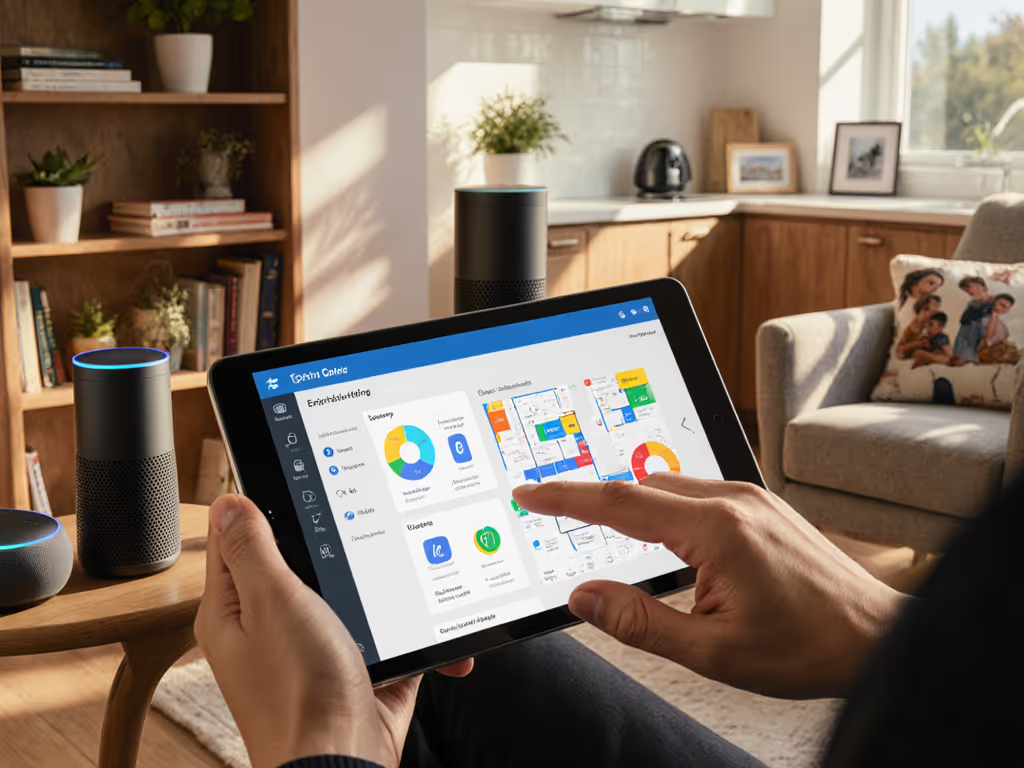
Begin by auditing your existing smart home hub (HomeKit, Alexa, Home Assistant, or SmartThings). Test its local automation capability in an internet outage. Then map your hydroponic sensors to Matter or Thread profiles, prioritize local data storage, and prototype a single automated routine (e.g., nutrient dosing) end-to-end before scaling. Document the latency and failure modes. From there, interoperability decisions will clarify themselves. The vendors betting on closed standards will eventually lose credibility; the ones embracing local, standards-compliant architectures will become the default. Measure, then migrate.